
The Green Bag Project: Ridgefield's easiest way to feed a neighbor
A reusable green bag, a few extra cans on every grocery run, and a volunteer who grabs it off your porch every other month. Here's the who, what, where, when and how before the December pickup.
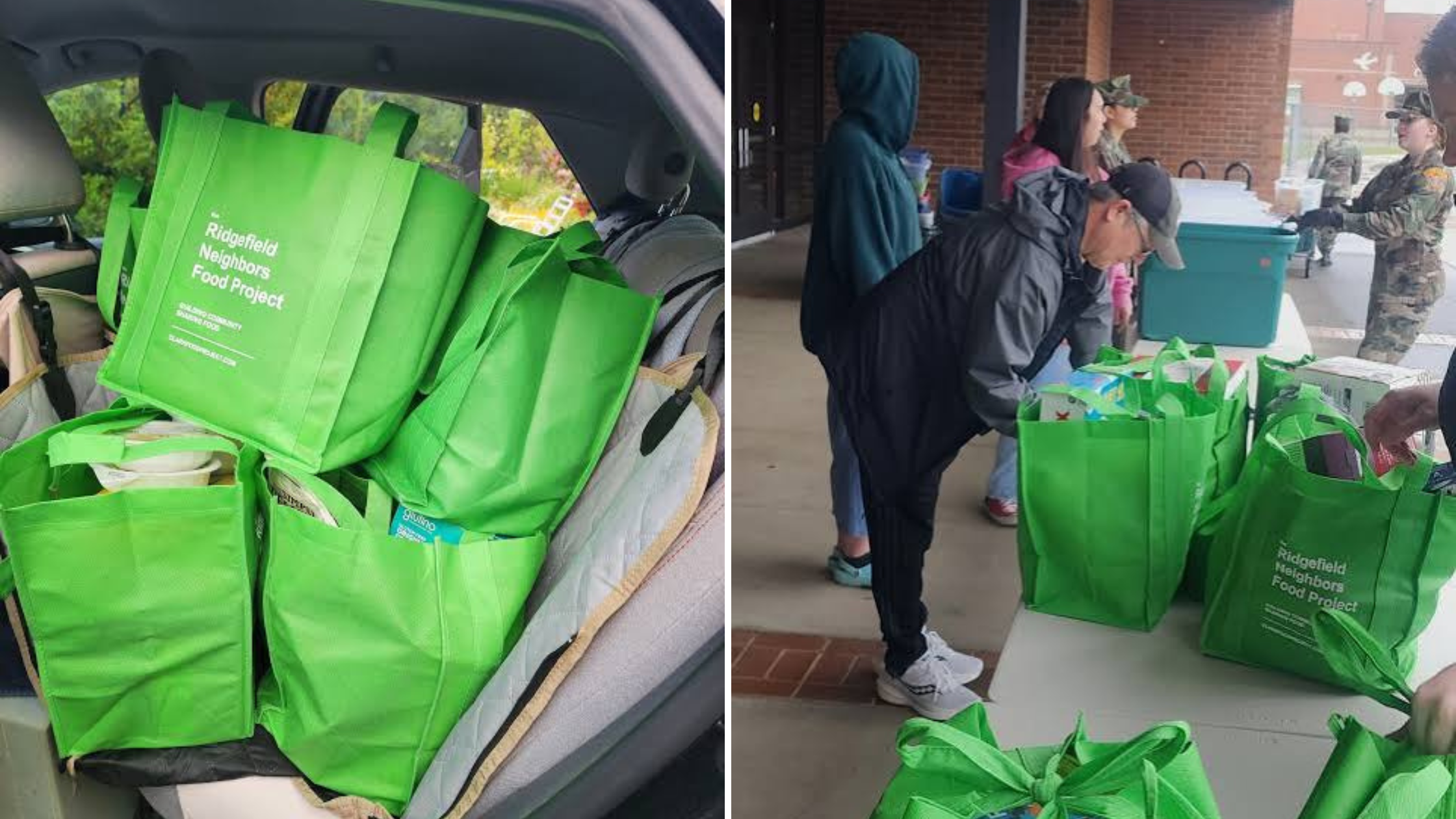
Confession: I learned about the Green Bag Project at a city council meeting, and not because anyone was talking about food. A volunteer got up during public comment to talk about lawn signs — specifically, the joy of re-applying to keep them up along the road (more on that rabbit hole below). Somewhere in the middle of the sign talk, it clicked. I'd seen those green bags on porches. I'd probably heard the name. It just never registered. So consider this my penance, and your cheat sheet, right as we head into the season when local pantries need it most.
The short version: you sign up, a neighbor drops off a reusable green grocery bag, you toss a few nonperishables in it over two months, and on pickup Saturday you leave it by your front door. A volunteer swaps it for an empty one and the food goes to pantries right here in Ridgefield. No drive to the food bank, no remembering where the donation bin is at the store. It is genuinely the lowest-effort way to do something good in this town, and I say that as someone who once thought Pure Barre had something to do with ballet.
What the Green Bag Project actually is
"Green Bag Project" is what most of Ridgefield calls it. Officially, it's the Ridgefield arm of the Clark Neighbors Food Project, an all-volunteer group that collects food door to door across Clark County. You'll also see it called the Ridgefield Food Project. Same bags, same people, same good.
The model didn't start here. The first Food Project began in Ashland, Oregon, in January 2009, and there are now 45 of them in 11 states — most of them up and down the West Coast. The Clark County version launched in July 2017 with 20 donors in Vancouver's Truman neighborhood, who gave 375 pounds of food in their very first collection. It has grown just a little since then.
One thing that trips people up: the Food Project is not the Clark County Food Bank. They partner closely — the Food Bank helps identify and vet the pantries that receive the food — but the green bags are their own volunteer-run operation.
How it works
Four steps. That's it. That's the whole commitment.
1. Sign up
Fill out the donor form on the Clark Neighbors Food Project site, or email the Ridgefield project directly at [email protected]. You'll be matched with a Neighborhood Coordinator who lives near you.
2. Get your bag
Your coordinator drops off a green bag and tells you when the next pickup is. You'll also get an email reminder before each pickup, which is great news for those of us whose brains are fully occupied by school pickup times.
3. Fill it slowly
The suggestion is to grab one or two extra nonperishable items every time you go grocery shopping. Over two months, that adds up to a full bag without ever feeling like a big spend. Some people fill it in one Costco run. No judgment either way.
4. Leave it out on pickup Saturday
Pickups happen on the second Saturday of every even month. Set the bag by your front door, and your coordinator grabs it, leaves a fresh empty one, and hauls everything to a drop-off point where volunteers weigh and sort it for the pantries.
The Green Bag Project at a Glance
What to put in the bag
Nonperishables only — your coordinator isn't running a refrigerated truck. The pantries have shared what they actually need, and it leans toward real, filling, protein-forward food over the dusty can of water chestnuts in the back of your pantry. (We all have one.)
A few insider tips: check expiration dates before anything goes in, skip glass when you can, and if you see a good sale, buy two and bag one. That last one comes straight from the Ridgefield Family Resource Center, and it's the easiest habit to build.
Where your food goes
This is the part I love. Ridgefield's green bags stay in Ridgefield. The food from local pickups is split between two places that feed our neighbors every single week.
Ridgefield's local food bank, serving the Ridgefield and La Center area. It runs almost entirely on volunteers and hands out food boxes to dozens of families each week, with deliveries to neighbors who can't make it in. Its shelves are stocked by the Clark County Food Bank, Rosauers, local churches and, yes, the green bags.
Distribution is on Tuesday mornings. Hours have shifted over the years, so call (360) 887-3354 to confirm before you go.
The district's resource center makes sure students and their families have food, toiletries, clothing and a soft place to land when things get hard. Green Bag food helps keep its small pantry stocked for kids who would otherwise go without.
Beyond food, the center gladly takes diapers and wipes, toiletries, laundry detergent, pet food, and gift cards — gas cards especially. Gift cards can be dropped at the district office at 510 Pioneer Street with a note that they're for the Family Resource Center.
By the numbers
I'm a sucker for a good stat, and the Food Project has some great ones. Across Clark County, more than 180 neighborhoods now donate food every two months. In 2025 alone, the project collected 172,486 pounds of food, and nearly 39,000 of those pounds came in during the December pickup. Since launching in 2017, it has collected over 900,000 pounds — roughly 750,000 meals.
The average green bag weighs about 12.5 pounds and carries roughly $20 worth of food. Closer to home, the school district has reported a single Ridgefield collection bringing in 2,100 pounds. Not bad for a town that still gets excited when a new coffee cart opens.
Notice that December number? That's the holiday bump, and it's exactly why now is the time to get on the list.
Want to do more? Become a Neighborhood Coordinator
The whole system runs on Neighborhood Coordinators — the people who drop off bags, collect them on pickup day and drive them to the sort. If your street, cul-de-sac or HOA doesn't have one yet, that could be you.
The best part: your "neighborhood" is whatever you want it to be. A few houses. A whole street. Your book club, your church small group, your hiking crew, your kid's soccer team parents. You round up a handful of donors, and every other month you spend an hour or two doing a porch-to-porch loop. You leave an empty bag and a thank-you card at each stop. Can't make the official Saturday? Coordinators can shift the date a week either way, as long as donors know. And if you truly can't make it, the project keeps a list of backup drivers.
Honestly, it's a sneaky-good way to meet your neighbors. In a town growing as fast as ours, that counts for something. Sign up through the Neighborhood Coordinator page. Prefer something with no route at all? The project also has a support team for things like unloading bags on pickup day and helping with special projects.
About those signs
Back to the council meeting that started all this. The volunteer's frustration was that keeping a sign up along the road means re-applying every 60 days. So I checked, and yes, that tracks with the city's rules.
So if you see a Green Bag sign pop up, disappear, and pop back up again, now you know why. The volunteers are just playing by the rules. Every 60 days. Like clockwork. Bless them.
Frequently asked questions
No. Fill what you can, when you can. If your bag only has three cans in it, put it out anyway. Every bit counts, and nobody is grading your bag.
You'll get email reminders, and your coordinator will usually give you a heads-up too. If you miss it, just keep filling and put it out next time.
Yes. The Clark Neighbors Food Project accepts monetary donations, and the Ridgefield Family Resource Center takes checks and gift cards through the school district.
The Food Project provides a donor tax sheet on its website to help you document what you've given. Check with your tax preparer on the details for your situation.
Start with Neighbors Helping Neighbors at (360) 887-3354, or, if you have kids in Ridgefield schools, the Ridgefield Family Resource Center at (360) 619-1412. You can also call 211 anytime for help finding food near you. Asking for help is exactly what these places are here for.
More from Meanwhile in Ridgefield
Here's the deal: we live in a town where the mayor goes down the slide at park openings and everyone waves at the guy in the orange vest. We take care of each other here. Sign up for a green bag before December 12, grab two extra cans on your next grocery run, and tag your neighbor who'd be a great coordinator. Spotted a green bag on a porch near you? Snap it and tag us. Let's fill some bags, Ridgefield.
