
The most boring document in Ridgefield decides what this town feels like in 2045
Envision Ridgefield 2045 is a twenty-year growth plan with a name that sounds like a corporate retreat. It is also the document that determines where roughly ten thousand new neighbors go, what downtown looks like when they get here, and whether any of this still feels like Ridgefield. Here it is without the planning jargon.

Nobody has ever curled up with a comprehensive plan. I want to be honest about that up front. It is a several-hundred-page municipal document full of words like "allocation" and "element," and reading it cover to cover is a choice you make about your own life. But here is the thing I keep coming back to: this is the single most powerful document in town. More than any one council vote, more than any one development application. It is the rulebook every future decision gets checked against, and we are in the year it gets locked in.
So let's translate it. No jargon, no civics lecture, just what it says and what it means for the street you actually live on.
What Envision 2045 actually is
Washington's Growth Management Act requires every city to keep a comprehensive plan that looks twenty years down the road, and to refresh it on a schedule. Ridgefield's current plan was adopted back in December 2016 and runs through 2035. Envision Ridgefield 2045 is the replacement, and it has been in the works since 2023 — the open houses, the surveys, the workshops at the Administrative and Civic Center, the tables at events where someone tried to hand you a comment card while you were holding a coffee and a kid.
The plan covers land use, housing, transportation, parks, public facilities, the environment, economic development, historic preservation and annexation. It carries the zoning maps. It carries the subarea plans for downtown and the waterfront, Ridgefield Junction, and Pioneer and 45th. If it changes what can be built where, it flows from this.
By the numbers
The county says how much. We say where.
This is the part most people get wrong, so it is worth slowing down on. Ridgefield did not sit in a room and decide to add ten thousand people. Clark County allocates growth to each city based on regional projections, and the city's job is to show it has room. You cannot decline. You can only decide how.
The city's answer has been consistent: concentrate density in mixed-use hubs where the water lines, roads and services already exist, rather than nudging density up evenly across every neighborhood. City Manager Steve Stewart made that case to the Clark County Planning Commission this month, describing an approach that targets density where the services and amenities to support it are already in place, mostly inside the existing city boundary.
The county's preferred plan does include an urban growth area expansion for Ridgefield of roughly 239 acres. Two pieces have gotten the most attention: a small parcel of about 14 acres already surrounded by the urban growth area, and the North Industrial Urban Reserve, which has been penciled in for future industrial and job growth since 1994. Nineteen ninety-four. Some of you were not born.
Five pieces that will show up in your actual week
Strip out the appendices and here is where this plan touches ground.
The preferred land use scenario keeps existing neighborhoods largely as they are and steers apartments, townhomes and mixed-use buildings toward specific hubs with the infrastructure to carry them. If you live on a quiet street, this is the sentence you have been looking for. If you were hoping for a walkable district with actual foot traffic, this is also the sentence you were looking for.
The tradeoff is real, though. Concentrated growth means some corners of town change a lot while others barely change at all, and the people who live near the hubs are the ones absorbing it.
The city's stated ambition has been to be a real employment center for north Clark County, not a place everyone drives out of at seven in the morning. That means industrial and employment land, and it means keeping the North Industrial Urban Reserve pointed at family-wage jobs rather than quietly converting it to more rooftops.
Watch this one. Employment land is the easiest thing in any comprehensive plan to lose to housing pressure, and it is the hardest thing to get back.
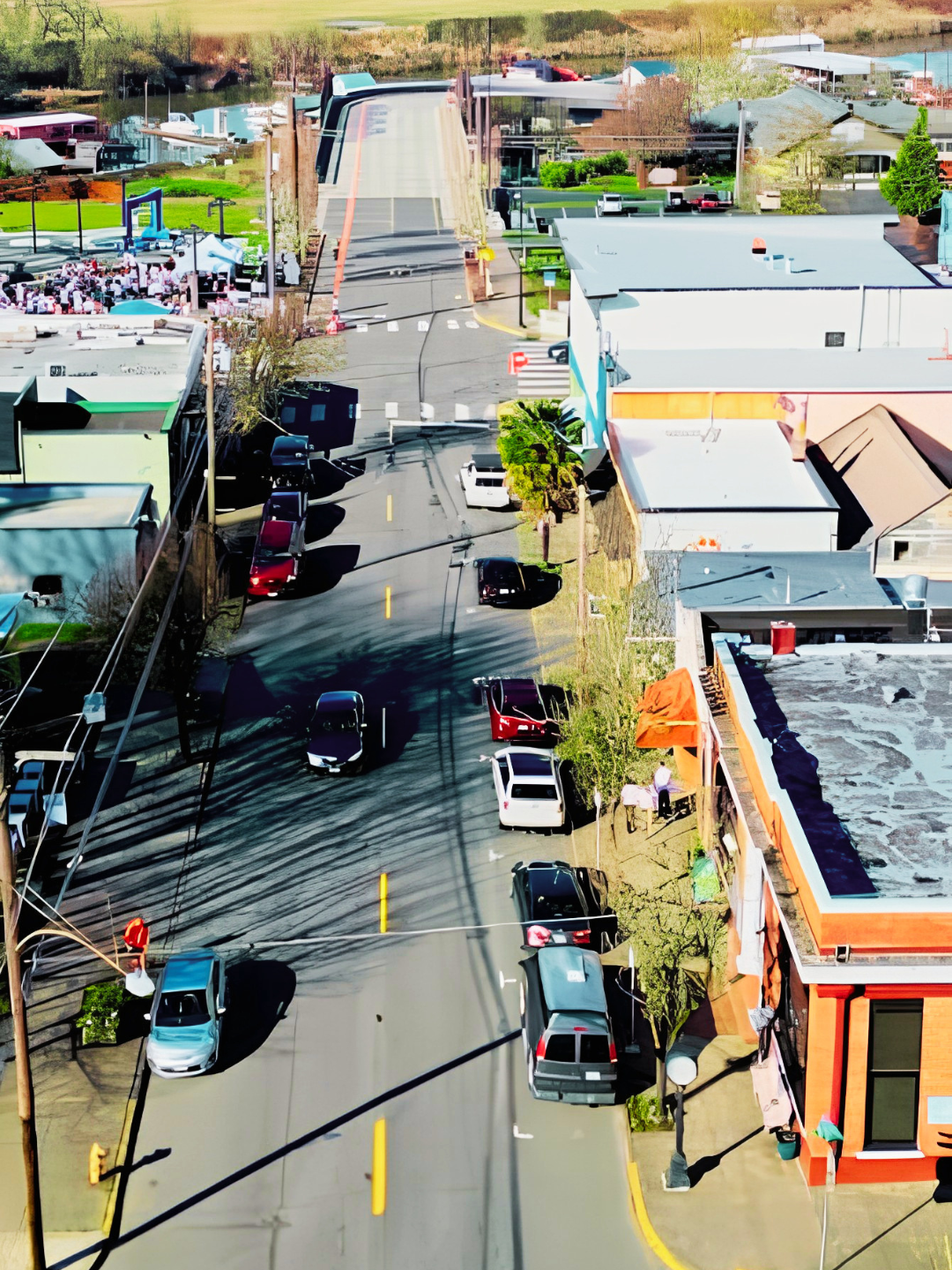
Downtown has its own subarea plan, which is where design standards, materials and streetscape decisions live. Council members have talked about downtown as the town's gathering space rather than just a walkable retail strip, and the redevelopment work around the former Park Laundry site is the current test case.
The Parks Capital Facilities Plan — the long-term list of park, trail and recreation investments with cost estimates attached — was adopted by council in May 2025, ahead of the full comprehensive plan. It is worth skimming if you have ever wondered why a trail stops where it stops.
Also still on the books: Ridgefield's requirement that new residential development set aside 25 percent open space. Mayor Matt Cole has pointed to that rule, along with design standards for building materials, as an example of how a planning goal written years ago shows up in what actually gets built. "We didn't want this to be just another anonymous, run-of-the-mill community," he said last year.
During a 2025 workshop, council members pushed to make historic preservation a standalone goal in the plan rather than a line item folded into general character language, on the theory that anything folded in gets forgotten. Councilor Rian Davis argued it would be an afterthought otherwise.
The practical version is storyboards — the historical signage Ridgefield Main Street has installed downtown, with interest in extending it along the trail network and out to the other side of the freeway. Small thing. Cheap thing. The kind of thing that makes a fast-growing town still feel like it came from somewhere.
What people actually argued about
The county-level version of this fight came to a head when the Clark County Council approved its preferred alternative earlier this year. Councilor Wil Fuentes voted no, arguing that cities like Ridgefield and La Center already hold enough land inside their existing boundaries to absorb twenty years of growth, and that expanding outward means sprawl, higher infrastructure costs and lost farmland. Mayor Cole read the same decision as a win for small cities.
Both of those things can be partly true, which is what makes it an actual argument rather than a talking point. The honest question underneath it: do you build up inside the line and accept that some neighborhoods change shape, or do you push the line outward and accept the roads, pipes and pavement that come with it? There is no version where nothing changes.
Questions people keep asking me
No. It means the city has to show it has zoned capacity for that many. Capacity and construction are different things, and the market decides the second one.
Not under state law. The Growth Management Act requires cities to plan for the growth allocated to them. What is genuinely up for debate is where it goes, how dense it is, what it has to look like, and what infrastructure has to be in place first.
Check the land use map on the Roundtable site rather than taking anyone's word for it, mine included. The preferred scenario leans on existing neighborhoods staying as they are, but "leans on" is not "guarantees," and the maps are the actual answer.
Not while it is still in front of the Planning Commission and council. Once it is adopted, it becomes the standard every future project is measured against, which is exactly why the boring phase is the important phase.
The part I actually care about
I moved here from New Jersey and fell for this town hard enough to start writing about it every week. What got me was not the scenery, though the refuge does not hurt. It was that the mayor goes down the same slide as a ten-year-old at a park opening and nobody finds it remarkable. That the store owners know your name. That growth here has, so far, mostly been accompanied by someone asking out loud whether it still feels right.
Twenty-year plans are how that either survives or quietly does not. The version of Ridgefield we get in 2045 is being typed into a Word document right now by people who would genuinely like to hear from you. Go be one of the people they hear from.
More from Meanwhile in Ridgefield
If you make it to a Planning Commission meeting, tell me what you saw. I will happily report it out — and if you would rather send it anonymously, you know where to find me. This town runs on people paying attention.
