
Ridgefield Is the Fastest-Growing City in Washington — Here's What That Actually Means
The numbers are official, the ranking is real, and if you've watched this town transform over the past few years, none of it will surprise you. But there's more to the story than a headline — including a city policy that's quietly making Ridgefield's growth story unlike almost anywhere else in the state.
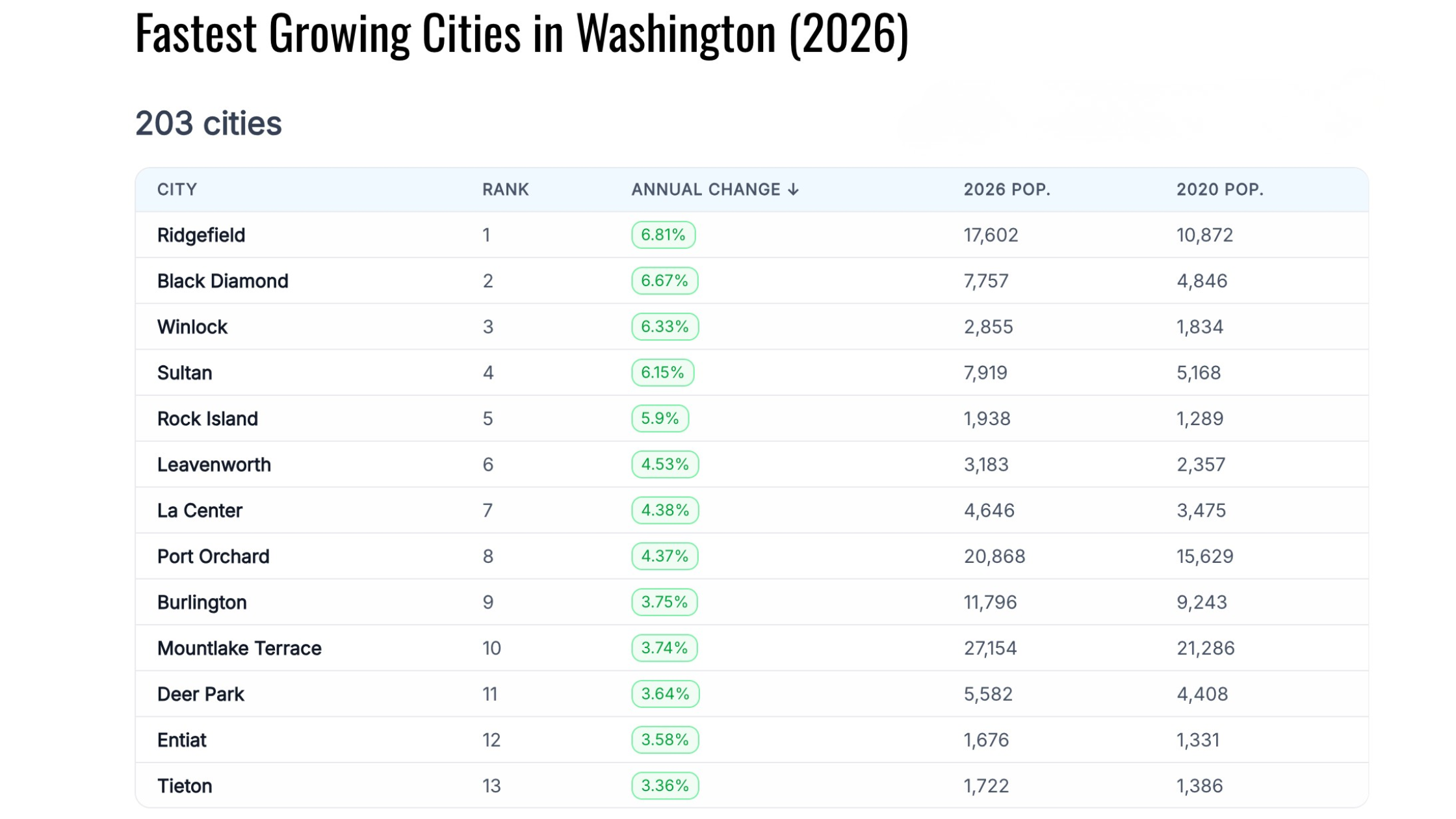
It's making the rounds on Facebook, and for once, the share-worthy claim is actually backed by solid data. Ridgefield, Washington — our town — is currently ranked the fastest-growing city in the entire state of Washington. Not one of the fastest. Not top ten. Number one.
The ranking comes from World Population Review, which tracks population trends across U.S. cities using data from the U.S. Census Bureau and the Washington State Office of Financial Management. Their 2026 numbers put Ridgefield at the top of the list, and a look at the actual figures makes it easy to understand why.
Source: World Population Review, 2026. Rankings based on annualized growth rates for Washington cities with populations over 1,000.
How Do They Actually Measure This?
Good question — and worth knowing, because "fastest-growing" is a phrase that gets thrown around loosely. Here's how it actually works.
How population growth rankings are calculated
- The baseline: Every ten years, the U.S. Census Bureau conducts a full population count — the Decennial Census. The most recent was 2020, which is the baseline Ridgefield's growth is measured against.
- Annual estimates: Between census years, the Washington State Office of Financial Management (OFM) releases official population estimates every April 1st. These are used by the state for funding decisions and tracking growth in fast-moving areas like Clark County.
- The growth rate formula: Organizations like World Population Review calculate annual growth rate as the change in population over a period of time — essentially, how much the city is growing year over year on average.
- One important note: These are estimates and projections, not a live headcount. They're highly reputable and widely cited, but they're built on modeling, not a door-to-door count. The next official census in 2030 will give us the real number.
For context: second place on the same list is Black Diamond at 6.67%, and third is Winlock at 6.33%. Ridgefield isn't just leading — it's pulling away. And this isn't a fluke or a single good year. Ridgefield has been in or near the top ten for years, with some of the most consistent growth numbers in the state.
Why Is Ridgefield Growing So Fast?
If you moved here in the last five or six years, you probably already know the answer intuitively. Ridgefield sits in a sweet spot that's hard to replicate: genuine small-town character, excellent schools, the Wildlife Refuge literally at the edge of town, and a straight shot down I-5 to both Vancouver and Portland. People who want to be done with city life — but still need to commute to it — keep landing here.
That dynamic was already in motion before 2020, but the pandemic reshuffled priorities for a lot of households, and remote and hybrid work made the calculus even easier. Ridgefield started showing up on more lists, more real estate searches, more "where should we move?" conversations. And it has kept showing up.
"Every new development in Ridgefield requires that at least 25% of the site be set aside for active and passive recreation, critical areas, and buffers."
— Mayor Matt Cole, Ridgefield City Council Community ChatThe Policy That Makes Ridgefield's Growth Different
This is the part that doesn't make it into most of the growth headlines — and it should. Mayor Matt Cole mentioned it at a recent spring council community chat, and it's worth understanding because it's one of the reasons Ridgefield doesn't feel like every other suburb that exploded during the same period.
City code here requires developers to set aside at least 25% of the whole development site for active and passive recreation, critical areas, and natural buffers. Not just a strip of grass along the fence line. A full quarter of the site. That land is then dedicated to the city after construction.
What "25% of the site" actually looks like
If a developer buys 20 acres to build a new residential neighborhood in Ridgefield, at least 5 of those acres must be set aside as parks, trails, open green space, wetland buffers, or similar. That land gets dedicated to the city — it's not a private amenity or a marketing feature. It becomes part of the public park and trail network that connects throughout town.
The city's own website describes it this way: this requirement "is one of the many things that makes, and keeps, Ridgefield unique" — and that it "ensures that these spaces are integrated with the built environment, and therefore easily accessible to residents and provide connections throughout the park and trail system."
It also means the parks and trails you see going in alongside new neighborhoods aren't an afterthought. They're baked into the deal from the start, funded in part through park impact fees paid by developers at the time of construction permits. The city then layers in grants and general fund allocations to actually build and maintain what's been set aside.
For anyone who loves Ridgefield's feel — the trails, the green connectors, the sense that you're not just in an endless subdivision — this policy is a big part of why that character has survived this level of growth.
So What Does This Mean Going Forward?
Ridgefield isn't slowing down. The infrastructure is catching up — Pioneer Street is being expanded, a Community Center is in the works, and new businesses and services continue to open in step with the population. Growth at this pace puts real pressure on roads, schools, water systems, and city services, and those conversations are ongoing at the council level.
But it also means Ridgefield has something that most rapidly growing cities don't: a policy framework that was designed with this moment in mind. The 25% rule wasn't written for a sleepy small town that expected to stay small. It was written for exactly this — and it's holding.
For those of us who moved here because of what Ridgefield felt like — and who want it to still feel that way when the next wave arrives — that's genuinely good news.
More from Meanwhile in Ridgefield
Got a question about what's changing in Ridgefield — or something you think the community should know about? Reach out, drop a comment, or find us on Facebook. This town is worth paying attention to, and that's exactly what we're here to do.
